Root rot is something no homeowner wants to hear. This is especially true if you really care about your lawn and how your trees look—not just today or tomorrow, but for months and years to come. Ironically, our team has found that while everyone has heard of root rot, very few know exactly what it is, what it looks like, or how to prevent it in the first place.
This isn’t a knock on our fellow homeowners. When it comes to tree diseases, decay, insects, and other health concerns, it can be overwhelming trying to keep up with it all. It’s challenging even for us tree professionals—and this is what we do every day!
That said, ignoring the signs of something like root rot can be costly.
Like anything else, root rot doesn’t just pop up overnight. It starts quietly, with subtle changes that are easy to dismiss. By the time it’s noticeable enough for you or your tree guy to be concerned, the damage may be too much to fix.
Ultimately, we want you to be as informed and educated as possible. So follow along as we dive into the topic of root rot.
What Is Root Rot?
Root rot is exactly what it sounds like—your trees’ delicate root system is rotting and decaying underground. The cause is a destructive fungal disease that develops when your tree and the surrounding soil remain overly wet for extended periods. This can happen for many reasons. For instance, you ran your water sprinkler for too long or on consecutive days. Or perhaps your area was hit by a lengthy storm that caused localized flooding. Regardless, the tree and the surrounding soil are waterlogged.
Combine that with insufficient sunlight to dry the ground beneath the tree, and root rot can become a major concern.
Root rot symptoms aren’t that much different from other tree diseases, so they tend to be easy to spot:
- Yellowing foliage
- Stunted growth
- Mushy, dark-brown or black roots
- A foul, decayed smell
- Premature leaf drop
- Eventual tree death or structural failure
- Soft or decaying wood
- A tree that starts to lean
- Fungal growth at the base
If your tree looks like it’s falling apart, root rot could be to blame.
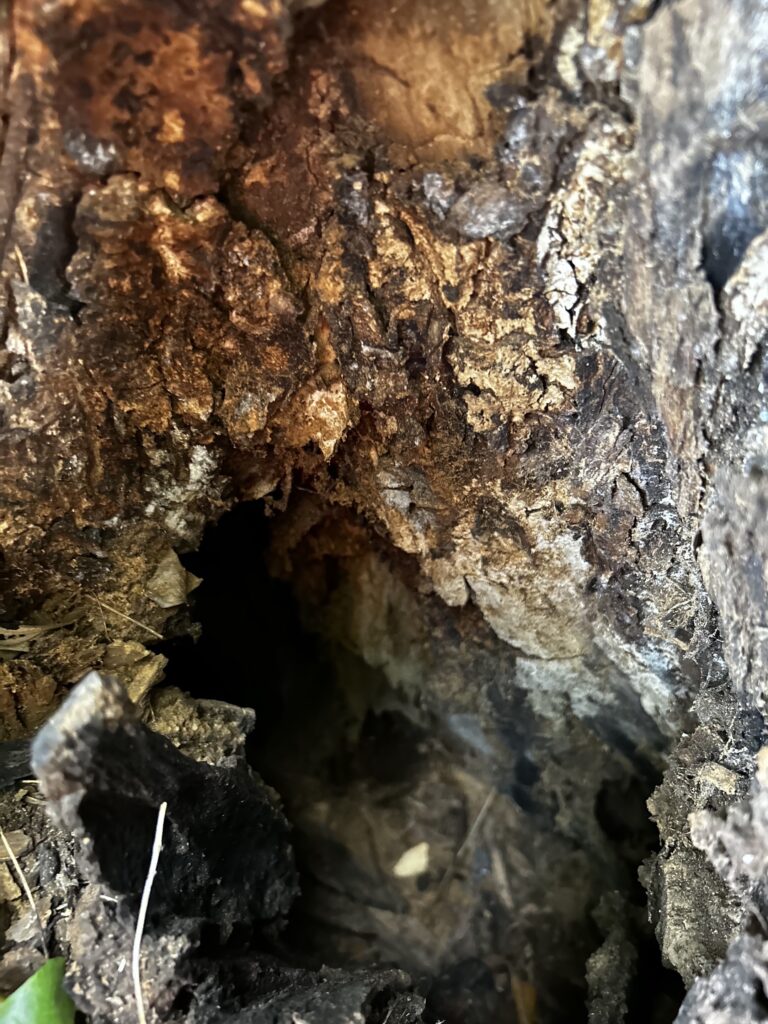
For instance, bark should be solid and firm to protect the tree. If your tree has root rot, the bark may be peeling, flaky, cracked, or soft to the touch. You may even notice pieces of bark lying around the base of the tree. Another telltale sign of root rot is the presence of rot and fungus at the base of the tree. This usually manifests as root damage, mushrooms, root flare, fungi, and even small but growing holes or cracks in the bark.
Is it Possible to Prevent Root Rot?
Yes, it is possible to prevent root rot. Admittedly, this will take a lot of work on your part and may require hiring a professional landscaper to monitor and treat the trees regularly. This way, your tree’s long-term health isn’t solely on your shoulders.
Here are a few tips to consider:
- Limit overwatering — While you can’t stop rain, you can reduce how much you water your lawn. If the soil beneath your tree isn’t draining correctly or too much water is pooling around the base of your tree, you may want to consider installing a drainage system.
- Invest in professional tree pruning — A properly pruned tree allows more sunlight to reach the base of your tree. As a result, you can use the sun to your advantage to dry up excess water.
- Regularly monitor your trees — This is sometimes easier said than done. But it’s a good idea to be mindful of what’s happening in your hard so that you can catch root rot earlier.
- Use raised beds or mounds — Slightly elevating the area where you intend to plant a new tree can help excess water drain more easily, keeping roots healthy and avoiding things like root rot.
- Mulch with purpose — A thin layer of mulch helps retain soil moisture without suffocating roots. Keep mulch a few inches away from the base of trees to prevent moisture from being trapped at the trunk.
- Only water during the day — A lot of people think watering at night is a wise move because the water can nourish the lawn without getting baked by the sun. The reality is that watering at night often leads to unnecessary disease and decay (including root rot) because the sun isn’t out to allow for excess water to evaporate.
If root rot has taken hold and compromised the tree’s structural integrity, it may be time to remove it. If left unattended, a tree with severe root rot could collapse and damage nearby structures (e.g., house, gazebo, garage). Arborists are masters at getting to the root cause (pun intended) of your tree’s issues and giving you an honest assessment of what should happen next. If the tree needs to be removed, Clean Edge Tree Service & Removal in Lewisville, TX, is an expert in quality, efficient, and safe large and dangerous tree removal—no matter whether it’s a 10-foot tree next to your garage or a tree that needs to be removed for land-clearing.
More than just mindlessly hacking off a few tree limbs with a chainsaw and hoping for the best, every cut we make has a purpose.
Call Clean Edge Tree Service & Removal Today!
We know you have options when it comes to your tree service and removal needs. Clean Edge Tree Service & Removal in Denton, TX, is family-owned and operated and has served Denton and surrounding areas since 2016. More importantly, we have the equipment, experience, and technical know-how to safely and efficiently handle any tree and residential or commercial scenario — from a downed tree in the middle of a storm to trimming a few branches, stump grinding, and removing trees that tower 83 feet in the air.
There isn’t a tree in Denton that we can’t handle. Call Clean Edge Tree Service & Removal today!