If you’re used to having big, beautiful trees on your property, deciding to remove even one or two can be difficult. After all, it’s those trees that give your home the curb appeal you’ve always wanted. Those same trees also provide welcome shade, increase privacy, and give the kids a fun area to play. It also doesn’t hurt that they earn plenty of compliments from neighbors and passersby. That said, you also understand that professional tree removal is sometimes necessary, especially if the tree is considered dangerous.
But therein lies the question you can’t quite shake: Is my tree dangerous enough to call someone now, or can I wait? Here’s the deal … if you want to wait, you certainly can. That said, if a professional tree removal company (especially ours) recommends removing your tree, or you’re already considering hiring a company for a specific tree job, it’s best to schedule the service sooner rather than later.
Not to scare you, but there are so many things that can go wrong with a dangerous tree.
The tree could:
- Fall on your home, garage, fence, or a nearby structure
- Injure a loved one, neighbor, visitor, or passerby
- Damage vehicles parked under or near it
- Fall on nearby power lines
- Drop large limbs without warning
- Block driveways and sidewalks
- Invite pests and disease to infect your healthy trees
Reality Check: Not Every Dangerous Tree Looks Dead
When many people think of dangerous trees that obviously need to be removed, they imagine a tree that’s lost all its leafy green foliage, has a few major limbs missing, and looks as though a light summer breeze could knock it over at any second. In other words, a dead tree. But a tree doesn’t have to be dead before it becomes dangerous. In fact, the U.S. Forest Service says that any tree can fail under the right combination of stressors—even one that appears healthy on the outside.
Internal decay, hidden disease, root damage, storm stress, and structural weaknesses often develop long before obvious warning signs appear. By the time these symptoms become noticeable, the problem has already advanced too far. The next thing you know, that tree that appears harmless and still looks as beautiful as ever can suddenly drop a large limb or snap near the trunk with little warning.
The good news is that trees rarely become dangerous overnight. The warning signs are subtle; you have to know what to look for. With that in mind, let’s take a look at some of the more common issues that can turn a healthy-looking tree into a dangerous tree.
6 Dangerous Tree Warning Signs
The tree is leaning — Not every leaning tree is dangerous. In fact, there are plenty of species that naturally lean to one side or the other. That said, a tree that wasn’t leaning a week or two ago, or that has a natural lean that has become more pronounced over the years, clearly shows that the tree is having trouble supporting itself. Sometimes, the extra leaning may resolve itself through structural pruning techniques that reduce uneven canopy weight. But many times, a lean means it should be removed.
The tree is too close to the house — This is a tough tree removal sign for homeowners to deal with, largely because the tree itself is probably perfectly healthy. The problem is that planting a tree too close to the house can eventually damage your home’s foundation. On top of that, a tree too close to the house can lead to pest infestation, roof damage, and more.
Your tree is diseased — One of the more common reasons a tree starts dying is because of holes or cracks in the bark caused by insects, rot, fungus, and other tree diseases. Your trees are bound to come in contact with termites, beetles, ants, various fungi, etc., as the years go by. But if this is allowed to happen long enough, there’s a good chance that the tree could buckle and fall, putting you, your property, everyday people passing by, and nearby structures in jeopardy.
An infected tree can create a chain reaction — Believe it or not, but certain tree diseases like Oak Wilt can essentially “leap” from tree to tree. For instance, oak trees growing near each other often share underground root systems. Over time, those roots naturally graft together, forming hidden connections beneath the soil. While this helps trees share water and nutrients, it also creates a direct pathway for disease. So, the longer a diseased tree is allowed to remain on a property, the more likely other trees will get sick, too. And when this happens, you may have to remove more than one tree.
Roots are lifting nearby concrete — Many of us live in neighborhoods with large trees planted on narrow strips of grass near the street. While this is a nice aesthetic, the reality is that their root system will grow over time in search of water and nutrients. As those roots grow, they can push against sidewalks, driveways, curbs, and foundations. This can lead to uneven or cracked concrete surfaces, creating not only cosmetic issues but also potential trip hazards and costly repairs.
Your tree is clearly dead already — Dead trees become less flexible and increasingly brittle the longer they are allowed to stay planted. Not only are they more difficult to remove, but they can also be more dangerous to cut down. On top of that, dead trees are more prone to uprooting and falling as they decay. Even if it’s not the entire tree, it could be one or two heavy branches. The next thing you know, the tree or its fallen limbs are on top of your house, car, or in the pool. God forbid if a dead tree falls and hurts someone.
When in Doubt, Call a Tree Removal Specialist
Even when you’re armed with the information above, it can still be difficult to know whether a tree has become hazardous. The safest and most reliable way to find out is to have it inspected by an experienced tree professional. In just a short visit, a knowledgeable tree specialist can evaluate not only the tree you’re concerned about, but also identify potential issues with other trees on your property before they become major problems.
With years of hands-on experience, professional tree removal specialists understand how to recognize structural weaknesses, signs of disease, insect damage, root problems, storm-related stress, and other conditions that may not be obvious to the average homeowner. Their goal is to provide an honest assessment and recommend the safest course of action based on the tree’s condition—not simply remove a tree that could otherwise be preserved.
An experienced tree professional does much more than simply remove trees. They can evaluate your property’s overall tree health, identify potential hazards, and recommend the safest and most cost-effective solution based on the tree’s condition. Some of the services they commonly provide include:
- Tree removal — Trees may need to be removed because of disease, insect infestations, structural instability, storm damage, construction projects, overcrowding, or safety concerns. An experienced tree professional can evaluate the situation and recommend whether removal or corrective pruning is the best solution.
- Tree pruning — Proper pruning is about much more than appearance. Knowing which limbs to remove, where to make each cut, and the appropriate time of year to prune helps promote healthy growth while reducing the risk of future storm damage.
- Emergency and storm clean-up — High winds, lightning, heavy rain, and falling limbs can quickly create hazardous situations. An experienced tree removal company has the equipment and expertise to safely remove damaged trees while protecting nearby homes, vehicles, fences, and other structures.
- Stump grinding — Professional stump grinding removes unsightly stumps, helps eliminate tripping hazards, discourages pests, and prepares the area for landscaping or future planting.
Call Clean Edge Tree Service & Removal Today!
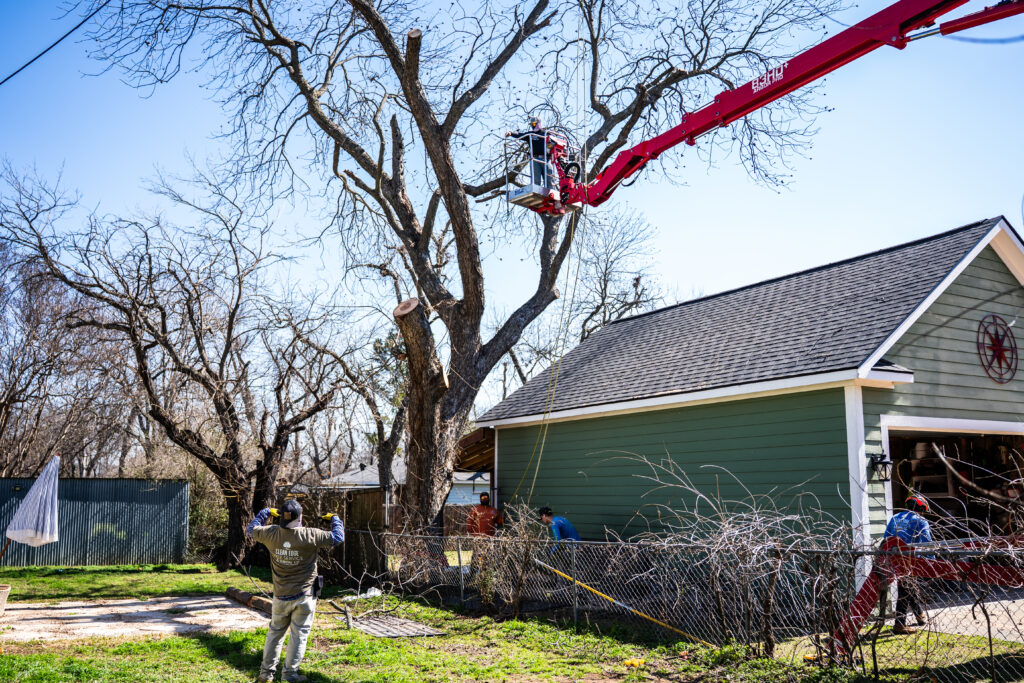
We know you have options when it comes to your tree service and removal needs. Clean Edge Tree Service & Removal in Denton, TX, is family-owned and operated and has served Denton and surrounding areas since 2016. More importantly, we combine state-of-the-art equipment, including our CMC 83 Arbor Lift Pro, with over 10 years of professional climbing experience to safely complete everything from routine tree trimming to complex hazardous tree removals. Whether a tree is located next to your home, growing over a fence, or requires sectional dismantling in a confined space, our experienced team has the knowledge and equipment to complete the job safely while protecting your property.
There isn’t a tree in Denton that we can’t handle. Call Clean Edge Tree Service & Removal today!