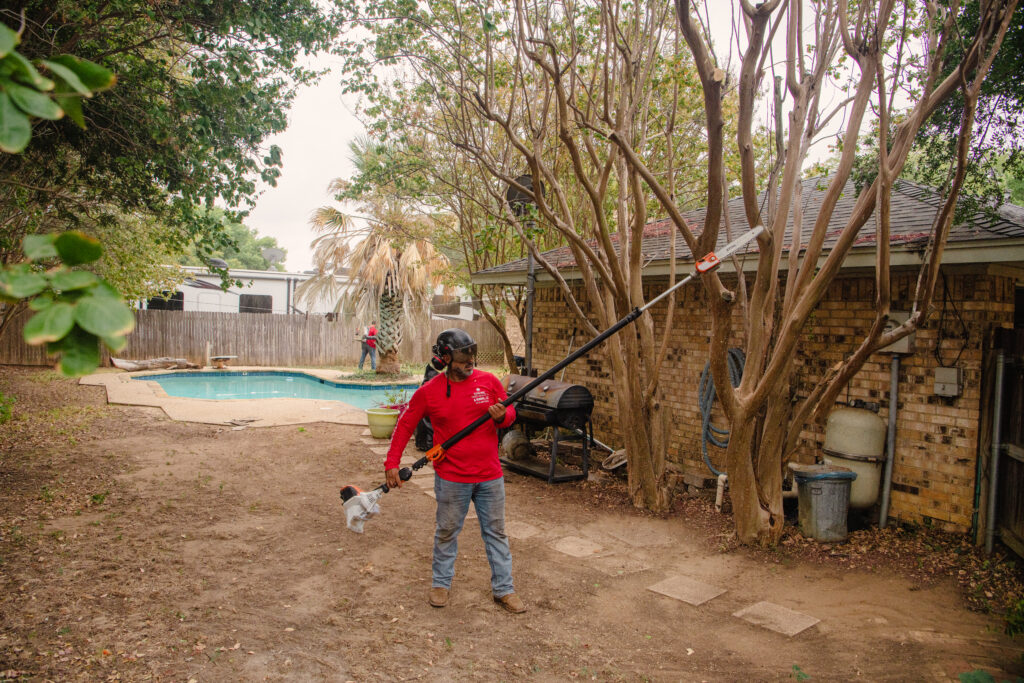
You’ve had a very beautiful crape myrtle in your front yard for the past several years. But it’s getting taller and wider, to the point where you’re considering trimming it back considerably to promote new growth. We love where your head is at—tree pruning is a solid option to keep your crape myrtle looking good and staying healthy. But the last thing you want to do is be accused of crape murder.
Yes, the term sounds aggressive and perhaps a bit dramatic. But in many ways, that’s exactly what many crape myrtle owners end up doing. Perhaps you’ve even seen pictures online, where the upper canopy is improperly chopped all the way down to uniform stubs.
We liken it to taking your kid to the barbershop for a buzz cut or a flat top.
The difference is that a flat top is harmless for haircutting purposes. For your crape myrtle, however … it’s crape murder.
Do These Signs of Crape Murder Sound Familiar?
- Flat, uniform cuts across the main trunk
- Trimming a tree by six feet or more all at once
- Thick, unsightly, permanent, gnarled knobs
- Whiplike, weak growth
- Drooping regrowth
- Loss of natural shape
Why Crape Murder Is a Bad Thing Long Term
The growing misconception these days is that the best way to prune a crape myrtle is to chop it down to very short limbs. No more leafy branches. No more crinkly summer blooms. Just a batch of thick, unsightly, and uniform stubs protruding from the ground. The belief is that by doing this, you increase the odds of better and more clustered blooms in the coming year. People also suggest that it gives the owner control over how big or small the tree gets. Plus, your neighbors are doing it … therefore, you should too.
The reality is that crape murder is one of the worst gardening crimes you can commit.
Sure, crape myrtles are highly resilient, and the odds are high that it will eventually recover from such a nightmarish cut. But it’s also highly possible that even with new growth, your tree will never look or perform the same way ever again. Such deliberate and aggressive cuts create too many open wounds and ultimately stress the tree. In an instant, it goes from sustaining insect damage to expending all its energy to drive new growth. As a result, the tree becomes stressed, and infestations become a significant problem.
How To Properly Prune a Crape Myrtle in Denton, TX
Rather than use a chainsaw to hack away at such a beautiful tree indiscriminately, you should …
- Remove low-hanging branches — These are located on the lower third of the trunk and make it harder to walk under the tree. If you have to duck to walk by your crape myrtle, these smaller branches are a natural and safe place to start your trimming efforts.
- Strategically thin the tree — Your tree guy can focus on opening up the center of the tree by removing crossing, rubbing, dead, or diseased branches. These branches are not only unnecessary, but removing them allows sunlight to beam through the tree.
- Focus on crown reduction — In instances where your crape myrtle is taller than it needs to be, especially if it is rubbing against the roofline or covering nearby windows, this is the professional way to reduce the height of the tree without damaging it.
With crown reduction, the goal is to trim back the higher, longer branches to another branch union, which may be only a few inches or a few feet away. Crown reduction has several benefits, such as reducing the tree’s height to keep it from becoming too top-heavy. Also, it avoids straight cuts that are too damaging to the tree. Instead, branches are cut back to laterals to limit the crown’s height and spread.
If you do a crown reduction throughout the canopy, you will have a shorter tree without topping it and stressing it.
Crape Murder Is Not and Never Has Been the Preferred Way To Trim Trees
Don’t commit crape murder, no matter how many images you see online or how many neighbors say it’s the right thing to do. Cutting back crape myrtles ultimately hurts your tree’s health and longevity by creating cuts that serve as entry points for insects and other fungal decay organisms. When in doubt, call a professional tree guy first. There is actually a science to proper tree trimming and pruning to keep them looking great and avoid a shortened lifespan. This includes knowing which limbs to cut, how and where to cut them, and when the best time of year is for trimming and pruning.
Our team of professionals at Clean Edge treats your trees as if they were our own.
Call Clean Edge Tree Service & Removal Today!
We know you have options when it comes to your tree service and removal needs. Clean Edge Tree Service & Removal in Denton, TX, is family-owned and operated and has served Denton and surrounding areas since 2016. More importantly, we have the equipment, experience, and technical know-how to safely and efficiently handle any tree and residential or commercial scenario — from a downed tree in the middle of a storm to trimming a few branches, stump grinding, and removing trees that tower 83 feet in the air.
There isn’t a tree in Denton that we can’t handle. Call Clean Edge Tree Service & Removal today!