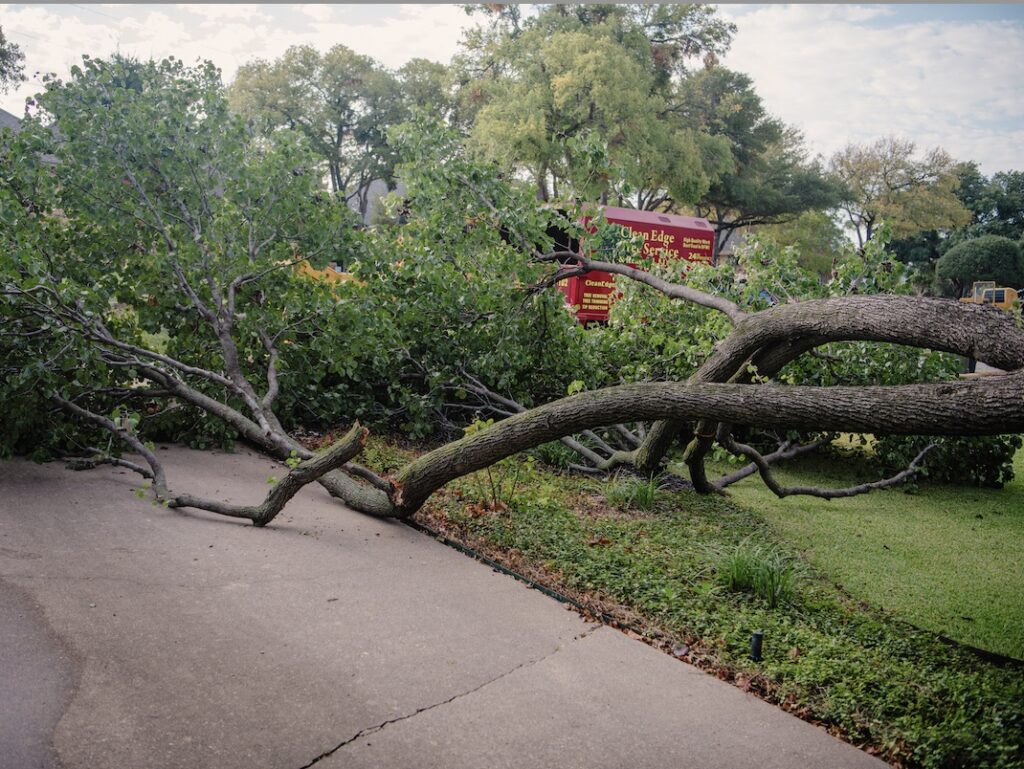
There are few things more frustrating than a North Texas storm. Here in Denton and throughout Denton County, we never know what one storm will bring compared to the next. Some pass through with little more than a brief rain shower, while others unleash damaging winds, hail, and torrential downpours. When severe weather strikes, practically nothing is immune to potential damage—including healthy trees. Yes, even a healthy tree can fall during a storm.
That last statement may come as a surprise. After all, most homeowners expect dead, dying, or visibly damaged trees to be the first to fail. And most of the time, that’s true. Weakened trees are naturally more susceptible to storm damage. However, even the healthiest trees can lose large limbs, split in half, or topple under the tremendous force of high winds, saturated soil, lightning, or other hidden structural weaknesses. One minute, a tree may simply be swaying in the wind, and the next, it’s lying across your driveway, on your roof, or crushing a nearby vehicle.
While a healthy tree is generally stronger than one that is diseased or neglected, no tree is completely storm-proof. Forestry experts agree that under the right combination of weather conditions and structural stressors, even a healthy-looking tree can fail.
What Can Cause a Healthy Tree To Fall During a Storm?
There are a variety of stressors and additional factors that can cause an otherwise healthy tree to fall during a storm. You may find that some of these are far more obvious than others, but trust us when we say they can all contribute, alone and together.
- High Winds — Most healthy trees can withstand winds up to 45 miles per hour. Anything more than that can lead to more significant damage. This is especially true if the winds are sustained over longer periods of time and also come with heavy wind gusts. Experts generally agree that no tree is safe when wind speeds reach 90 mph or higher.
- Soil erosion — The combination of long-term heavy rain and winds can saturate the ground and soften the soil so significantly that the roots of an otherwise healthy tree become compromised and protective soil washes away.
- Lightning — Even if your healthy tree stands up to the first two conditions on this list, it could still be susceptible to a random lightning strike. A single lightning strike contains about 300 million Volts and about 30,000 Amps. In comparison, household current is 120 Volts and 15 Amps. That is more than enough to potentially split a tree in half. Even if the tree survives a lightning strike, there could be hidden cracks and internal damage that make it more prone to falling over in future storms.
- Root damage — Just because a tree is healthy and thriving up top doesn’t mean there aren’t issues beneath the surface. Driveway installations, heavy foot traffic, utility trenching, etc., can all damage a tree’s root system. If the tree’s roots have been compromised, it no longer has a strong foundation upon which to stand up to whatever Mother Nature throws at it.
- Poor root development or shallow roots — Either of these factors can go largely unseen for years and keep the tree from forming a solid enough foundation. This can lead to the tree falling in a storm, even when it looks healthy up top.
- Heavy canopies — We’ve written about this one before. Denton trees can grow in awkward ways, either on their own, because of poor pruning practices, competition from nearby trees, or due to a natural response to other unknown environmental conditions. As a result, they can develop canopies that are heavier on one side than the other. Since the top of the tree is the heaviest and most vulnerable, an asymmetry or uneven distribution could cause the tree to buckle and fall in a storm.
- Overextended limbs — To piggyback on heavy canopies, many large and lengthy limbs can ultimately grow to the point where they extend too far beyond the canopy. This creates a lever effect that is exacerbated in strong winds. This places undue pressure on the tree to stay upright. Also, if these longer limbs crack or fall, this can destabilize the tree overall.
- Co-dominant stems — Some trees have more than one main trunk competing for dominance. While this may give your tree character in comparison to other nearby trees, it also represents a weak point that a significant storm can exploit.
- Lack of consistent pruning — When your trees haven’t been pruned, they can become a hazard and are more susceptible to failing during a storm. This is because the tree is overcrowded, and wind cannot easily pass through the canopy. As a result, the wind and rain combination can essentially push the tree over.
- Hidden internal decay — Denton trees can buckle under their own weight and fall in a storm if there is a sizable issue internally with decay. Over time, tree trunks can deteriorate into hollow tubes that can no longer support the tree’s weight.
A professional tree inspection can identify structural weaknesses that homeowners often cannot see from the ground.
Signs Your Tree May Be More Vulnerable Than It Looks
- Leaning more than it used to
- Soil lifting around the roots
- Cracks in the trunk
- Mushrooms near the base
- Large dead limbs
- Cavities
- Heavy limbs extending over your home
Even if your tree appears healthy, these warning signs warrant a professional inspection.
Benefits of Tree Pruning to Prevent Storm Damage
There is no way to completely prevent a healthy tree from falling during a storm. That said, trees that have been professionally pruned have a far greater survival rate than those that have been allowed to become overgrown. There’s a science to proper tree trimming and pruning. Our team has several approaches that deliver exactly what your tree needs:
1. Crown Reduction — Reducing the tree’s height to keep it from becoming too top-heavy and leading to damage.
2. Crown Cleaning — Remove weak, diseased, dead, and hazardous branches. Also remove branches that cross and rub together.
3. Crown Raising — Cut limbs and branches that are too close to structures and power lines. It is also suitable for low-hanging branches that pose hazards or that interfere with activities such as mowing or hanging out in the front yard.
4. Crown Thinning — Cuts that focus on reducing weight on heavier limbs, improving sunlight, limiting the spread of disease, and reducing drag caused by heavy winds.
Call Clean Edge Tree Service & Removal Today!
Storm damage often begins long before the first raindrop falls. Scheduling routine tree pruning and inspections can dramatically reduce the likelihood of broken limbs, property damage, and costly emergency removals after severe weather.We know you have options for your tree service and removal needs. Clean Edge Tree Service & Removal in Denton, TX, is family-owned and operated and has served Denton and surrounding areas since 2016. More importantly, we have the equipment, experience, and technical know-how to safely and efficiently handle any tree and residential or commercial scenario — from a downed tree in the middle of a storm to trimming a few branches, stump grinding, and removing trees that tower 83 feet in the air.
There isn’t a tree in Denton that we can’t handle. Call Clean Edge Tree Service & Removal today!